
Table of Contents
A research team at the Dalian Institute of Chemical Physics (DICP), part of the Chinese Academy of Sciences, has developed a new industrial process that generates hydrogen from seawater while simultaneously producing fresh water — turning what is normally a wasted byproduct of electrolysis into a second, valuable output.
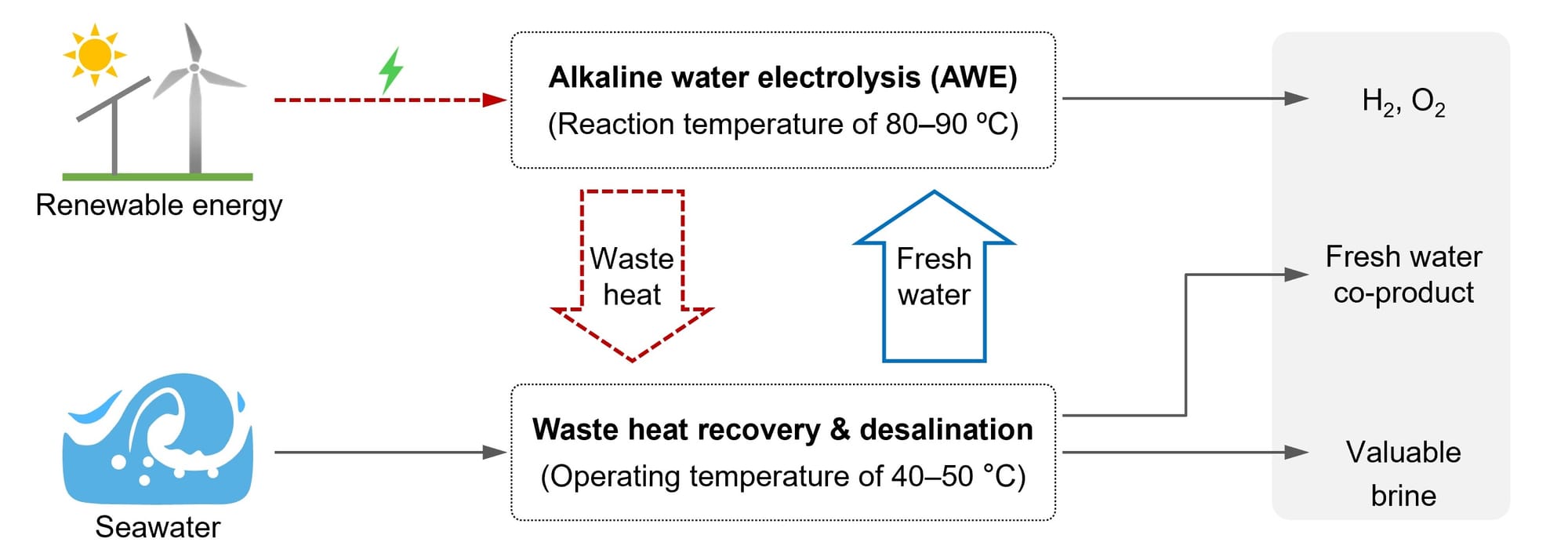
The findings, published in Nature Energy on September 15, describe a system led by Prof. Deng Dehui and Associate Prof. Liu Yanting that the team calls "seawater to hydrogen and fresh water," or STHW. The approach couples standard alkaline water electrolysis with a low-temperature vacuum distillation process for desalination.
Seawater has long been viewed as a promising, virtually limitless feedstock for green hydrogen production, but harnessing it directly has proven difficult. Running an electric current through untreated seawater — a process known as electrolysis, which splits water molecules into hydrogen and oxygen — tends to corrode electrodes and reduce efficiency. Using purified fresh water avoids that problem but is energy-intensive and does nothing to ease water scarcity in the coastal regions where such plants are often built.
The DICP team's solution exploits a phenomenon common to all electrolysis systems: a substantial portion of the energy put into the process is lost as low-grade waste heat. Instead of letting that heat dissipate, the STHW system redirects it to drive low-temperature vacuum distillation, desalinating incoming seawater. The resulting fresh water is fed back into the electrolyzer and also made available for external use. Even the leftover concentrated brine isn't wasted — it can be processed to recover salt, uranium and bromine.
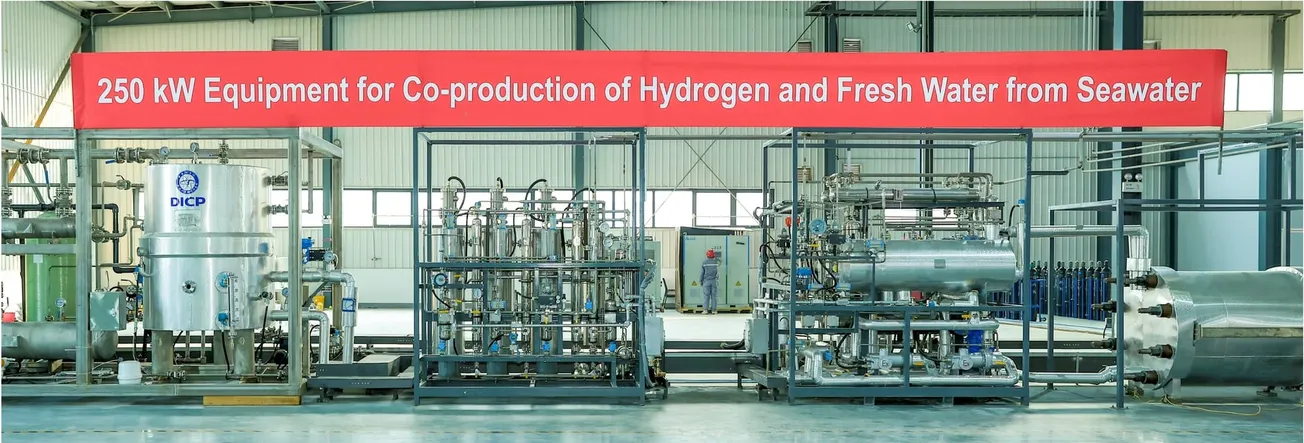
To test the concept beyond the lab, the researchers built a 20-kilowatt pilot system that ran continuously for 100 days, producing 3.8 cubic meters of hydrogen per hour along with 1.2 kilograms of fresh water hourly. They then scaled the design up to a 250-kilowatt system, which produced 48 cubic meters of high-purity hydrogen per hour and 31.6 kilograms of fresh water per hour. Notably, the larger system also achieved a 14.4% improvement in electrical efficiency compared with conventional alkaline electrolysis using fresh water alone.
"This study addresses two key challenges in seawater-based hydrogen production: using low-grade waste heat from water electrolysis and overcoming the stability and energy-efficiency limitations of direct seawater electrolysis," Deng said, adding that the approach offers a potential pathway toward more efficient hydrogen production paired with fresh water generation.
The dual-output design could make the technology particularly attractive for coastal industrial facilities and desalination-dependent regions, where the ability to generate both a clean fuel and usable water from the same input — seawater — addresses two infrastructure needs simultaneously. With a 250-kilowatt system already demonstrating stable performance, the DICP team's next challenge will likely be further scale-up toward commercial deployment.